What Comes After Trillion Unveiling Numbers Beyond Human Imagination
Table of Contents
- Understanding the Scale: What Exactly Is a Trillion?
- Numerical Definitions and Systems: Short vs. Long Scale
- Scientific and Binary Representations
- Real-World Analogies for Trillion-Scale Quantities
- Hierarchy of Large Numbers: From One to Sextillion
- Beyond the Trillion: Exploring the Vast Scale of Mathematics and Science
- Named vs. Unnamed Large Numbers in Science and Mathematics
- Googol and Googolplex: Origins and Theoretical Significance
- Monstrous Numbers in Advanced Mathematics: Skewes’ and Graham’s Numbers
- Table: Largest Named Numbers in Mathematics and Their Fields of Relevance
- Trillions in Economics, Finance, and Global Spending
- National Debt and Global GDP: The Trillion-Dollar Benchmarks
- Trillion-Dollar Industries: Tech, Healthcare, and Defense as Economic Powerhouses
- Historical Milestones: From Corporate Valuations to Stock Market Landmarks
- Government Budgets and Trillion-Dollar Policies
- Trillions in Technology, Data, and Computing
- Big Data Analytics and AI Training Datasets
- Cryptographic Keyspaces and Quantum Computing
- Trillion-Node Networks and Scalability Challenges
- Supercomputers and Cloud Performance Metrics
- Storage Capacity of Trillion-Byte Datasets
- Trillions in Astronomy, Physics, and the Universe
- Cosmic Distances and the Scale of Trillions
- Atomic and Particle Scales: Avogadro’s Number and Beyond
- Extreme Temperatures: Trillions of Degrees in Cosmic Phenomena
- Time and the Universe: Trillions of Seconds and Multiverse Speculations
- Visualizing a Trillion Meters in Astronomical Context
- Cultural and Pop Culture References to Trillions
- Trillions in Film, Literature, and Television
- Trillions in Gaming and Virtual Economies
- Trillions in Conspiracy Theories and Speculative Fiction
- Trillions in Music and Symbolic Meanings
- Trillions in Advertising and Branding
- The Limits of Human Understanding: Cognitive Barriers to Comprehending Trillions
- Cognitive Biases Distorting Perception of Trillions
- Visualization Techniques to Bridge the Abstraction Gap
- Art and Design: Representing Trillions Beyond Numbers
- Educational Strategies for Teaching Large Numbers to Children
- Trillions in Existential and Philosophical Thought
Humanity’s grasp of scale has always been stretched to its limits when confronted with numbers like a trillion—an abstract figure that dwarfs everyday experience yet shapes global economies, cosmic distances, and technological frontiers. Beyond this milestone lie realms where mathematics, physics, and economics collide, revealing figures so vast they defy intuition, from the quadrillions governing national debts to the googolplexes lurking in theoretical physics. These numbers are not mere digits; they are gateways to understanding the universe’s hidden architecture, where a single miscalculation can redefine reality.
The journey from trillion to sextillion and beyond exposes the fragility of human perception, where even the most advanced minds struggle to visualize quantities that exceed the scale of galaxies or the age of the cosmos. Yet, these numbers are not just theoretical constructs—they underpin the algorithms powering artificial intelligence, the budgets dictating geopolitical power, and the speculative fiction that fuels cultural imagination. By dissecting their origins, applications, and the cognitive challenges they present, we uncover how humanity both wields and wrestles with the incomprehensible.
Understanding the Scale: What Exactly Is a Trillion?

A trillion represents a numerical magnitude so vast that it defies everyday intuition, yet it underpins economic forecasts, astronomical measurements, and scientific calculations. To grasp its scale, one must examine its formal definitions across different numerical systems, its mathematical representation, and tangible comparisons rooted in observable phenomena. The distinction between the short and long scale systems further complicates perception, as does its position in the exponential hierarchy of large numbers. This section dissects the trillion’s numerical identity, contextualizes it through real-world analogies, and maps its place in the broader spectrum of cosmic and computational quantities.
Numerical Definitions and Systems: Short vs. Long Scale
The value of a trillion varies depending on the numerical naming system used. In the short scale (predominantly used in the U.S., India, and modern digital contexts), a trillion equals 1,000,000,000,000 (1012), derived from the Latin trillies, meaning "three times a thousand squared." Conversely, the long scale (historically used in Europe and some non-U.S. systems) defines a trillion as 1,000,000,000,000,000,000,000,000 (1018), or a million trillion, reflecting an older convention where each new term adds two zeros beyond the previous. This discrepancy arises from the long scale’s systematic increment of scale names by powers of a million, whereas the short scale increments by powers of a thousand.
Short Scale (U.S.): 1 trillion = 1012 (1,000,000,000,000) Long Scale (non-U.S.): 1 trillion = 1018 (1,000,000,000,000,000,000)
The table below compares the two systems for numbers from million to quintillion, illustrating how the long scale’s trillion aligns with the short scale’s trillion trillion (1024).
| Number | Short Scale (U.S.) | Long Scale (non-U.S.) |
|---|---|---|
| 106 | 1 million | 1 million |
| 109 | 1 billion | 1 thousand million |
| 1012 | 1 trillion | 1 million million |
| 1015 | 1 quadrillion | 1 thousand trillion |
| 1018 | 1 quintillion | 1 trillion |
| 1021 | 1 sextillion | 1 thousand trillion |
| 1024 | 1 septillion | 1 million trillion |
The confusion between scales persists in global contexts, particularly in finance and science, where miscommunication can lead to errors. For instance, the European Central Bank historically used the long scale, while the U.S. Federal Reserve adopted the short scale, creating potential ambiguities in cross-border financial reporting.
Scientific and Binary Representations
In scientific notation, a trillion (short scale) is expressed as 1012, a compact form essential for fields like physics and astronomy where such magnitudes are routine. This notation simplifies calculations involving exponents, such as estimating the number of atoms in a mole (Avogadro’s number, ~6.022 × 10²³) or the energy output of supernovae (1044–1046 ergs). Binary representation, critical in computing, converts 1012 to 239.897, or approximately 240 (1,099,511,627,776), reflecting how digital systems quantify data storage (e.g., 1 terabyte ≈ 1012 bytes).
Scientific Notation: 1 trillion (short) = 1012 = 1,000,000,000,000 Binary Approximation: 1012 ≈ 240 (1,099,511,627,776)
The binary gap between powers of 10 and 2 underscores why computer scientists prefer base-2 for memory calculations, while scientists often default to base-10 for human readability.
Real-World Analogies for Trillion-Scale Quantities
Abstract numbers gain clarity through concrete comparisons. A trillion seconds equates to 31,709.8 years—longer than recorded human civilization. The estimated number of grains of sand on Earth ranges from 7.5 × 10¹⁸ to 1021, exceeding even the long scale’s trillion (1018). Astronomically, the Milky Way galaxy contains roughly 100–400 billion stars (1011–1012), while the observable universe may hold 2 × 1024 stars—a sextillion, or 2,000 trillion in the short scale.
- Time: 1 trillion seconds = 31,709.8 years (since ~19,700 BCE). Context: Early agricultural societies emerged around 10,000 BCE, making a trillion seconds a span encompassing multiple Neolithic revolutions.
- Sand Grains: Earth’s beaches and deserts contain ~7.5 × 10¹⁸ grains (long scale’s trillion). Context: If distributed evenly, each grain would cover ~1.6 km2 of land.
- Stars: The Andromeda Galaxy (M31) has ~1 trillion stars (1012), visible as a smudge in the night sky. Context: Its diameter spans ~220,000 light-years, yet its stellar density is sparse—stars average 4.3 light-years apart.
- Data Storage: 1 terabyte (TB) ≈ 1012 bytes, storing ~250,000 high-resolution photos. Context: The Large Hadron Collider generates ~30 petabytes (30 × 1015) of data annually—30,000 trillion bytes.
These examples illustrate how trillions bridge microscopic and cosmic scales, from the granular to the galactic.
Hierarchy of Large Numbers: From One to Sextillion
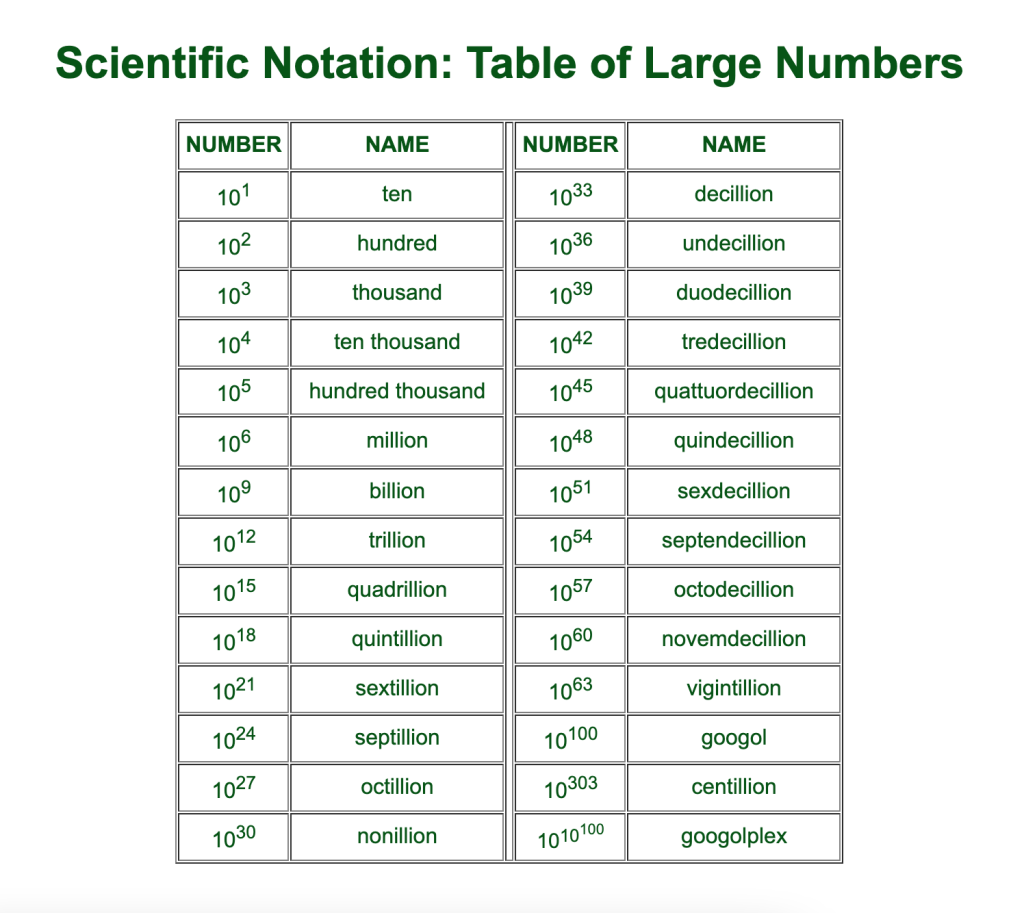
To situate a trillion within the exponential hierarchy, consider the progression from 1 to 1024 (sextillion), where each step represents a thousandfold increase. This hierarchy reveals the logarithmic growth of numbers, where each name marks a new order of magnitude:
1. 100 (1) – Unity, the foundation of all counting. 2. 103 (1,000) – A
Beyond the Trillion: Exploring the Vast Scale of Mathematics and Science
Numbers beyond a trillion push the boundaries of human imagination, transcending everyday experiences and entering realms where abstract mathematics, theoretical physics, and computational limits converge. While a trillion (1012) is already an astronomical figure, the scale escalates exponentially with each subsequent term—quadrillions, quintillions, and beyond—until reaching constructs like a googol (10100) or Graham’s number, which defy conventional comprehension. These numbers are not merely theoretical; they emerge in cosmology to quantify the universe’s potential particle count, in computer science to define computational limits, and in advanced mathematics to solve complex proofs. Understanding their structure, applications, and comparative magnitudes reveals how humanity grapples with infinity’s edge.
Named vs. Unnamed Large Numbers in Science and Mathematics
The distinction between named (e.g., trillion, quadrillion) and unnamed (e.g., 1030, 10100) large numbers reflects their origins—whether derived from systematic naming conventions or arbitrary scientific notation. Named numbers follow a predictable pattern in the short scale (used in the U.S. and most English-speaking countries), where each term increases by a factor of 1,000: - Trillion: 1012 - Quadrillion: 1015 - Quintillion: 1018 - Sextillion: 1021
In contrast, unnamed numbers like 1080 (the estimated number of atoms in the observable universe) or 10100 (a googol) lack linguistic labels but serve critical roles in cosmology and quantum mechanics. For instance, the Planck length (10-35 meters) and Planck time (10-43 seconds) define the smallest measurable units in physics, while 10120 approximates the number of possible quantum states in the universe—a figure central to multiverse theory.
In computer science, unnamed numbers define limits like 264 (the maximum addressable memory in a 64-bit system) or 1075 (the theoretical upper bound for a 256-bit integer). Meanwhile, named numbers like googol (10100) or googolplex (10googol) illustrate the human tendency to anthropomorphize scale, blending humor with mathematical rigor.
Googol and Googolplex: Origins and Theoretical Significance
The googol (10100) was coined in 1938 by mathematician Edward Kasner during a conversation with his nine-year-old nephew, Milton Sirotta. Kasner sought a term to describe an unimaginably large number, and the name stuck due to its simplicity and memorability. A googol is: - 1 followed by 100 zeros, vastly exceeding the number of atoms in the observable universe (~1080). - Larger than the total number of possible poker hands (1016) or stars in all galaxies (estimated at 1024).
Its practical applications are limited, but it serves as a benchmark for infinity in informal discussions. The googolplex (10googol), a number so large it cannot be written out in decimal form without collapsing the universe, was introduced as a humorous extreme. While meaningless in most scientific contexts, these terms highlight humanity’s fascination with scale and the psychological comfort of assigning names to the incomprehensible.
In theoretical mathematics, googol-related concepts appear in discussions about uncomputability and large cardinal numbers, where they symbolize boundaries beyond practical calculation. For example, Rayo’s number (a multifactorial extension of Graham’s number) is so vast that it renders even a googolplex trivial by comparison.
Monstrous Numbers in Advanced Mathematics: Skewes’ and Graham’s Numbers
Some numbers transcend utility, existing solely to prove theoretical limits in mathematics. Skewes’ number (first estimated at ~101010, later refined to ~10101034) emerged from Ramsey theory, a branch studying order within chaos. It represents the point where the distribution of prime numbers becomes random enough to satisfy a specific probabilistic condition—a concept with no real-world application but profound implications for number theory.
Even more infamous is Graham’s number, derived from a problem in Ramsey theory (specifically, hypergraphs). Its magnitude is so extreme that it requires Knuth’s up-arrow notation to express: - Graham’s number > 10101010101010101010101010 (a tower of exponents 64 levels high). - It dwarfs a googolplex and is so large that writing it out would require more particles than exist in the universe.
Graham’s number is purely existential—it proves that certain mathematical structures exist but offers no computational or physical insight. Its inclusion in popular culture (e.g., The Simpsons, XKCD) underscores the public’s intrigue with unfathomable scales.
Table: Largest Named Numbers in Mathematics and Their Fields of Relevance
The following table compares the most extreme named numbers in mathematics, their approximate values, and their scientific or theoretical contexts. Values are presented in scientific notation for clarity, with fields of application noted where applicable.
| Number | Approximate Value | Field of Relevance | Key Application or Context | ||||||||||||||||||||||||||||||||||||||||||||||||||||||||||||||||||||||||
|---|---|---|---|---|---|---|---|---|---|---|---|---|---|---|---|---|---|---|---|---|---|---|---|---|---|---|---|---|---|---|---|---|---|---|---|---|---|---|---|---|---|---|---|---|---|---|---|---|---|---|---|---|---|---|---|---|---|---|---|---|---|---|---|---|---|---|---|---|---|---|---|---|---|---|---|
| Googol | 10100 | Mathematics, Informal Science | Benchmark for "large" numbers; used in discussions of infinity and uncomputability. | ||||||||||||||||||||||||||||||||||||||||||||||||||||||||||||||||||||||||
| Googolplex | 10googol (1010100) | Mathematics, Humor | Hypothetical upper limit for naming large numbers; no practical use. | ||||||||||||||||||||||||||||||||||||||||||||||||||||||||||||||||||||||||
| Skewes’ Number | ~10101034 | Number Theory, Ramsey Theory | Upper bound for prime number distribution anomalies in probabilistic models. | ||||||||||||||||||||||||||||||||||||||||||||||||||||||||||||||||||||||||
| Graham’s Number | >101010101010101010101010 | Combinatorial Mathematics, Ramsey Theory | Upper limit in a problem about hypergraphs; no computational relevance. | ||||||||||||||||||||||||||||||||||||||||||||||||||||||||||||||||||||||||
| Raymond’s Number | >Graham’s number | Mathematics (Multifactorial Extension) | Created to surpass Graham’s number; used to illustrate recursive growth in notation. | ||||||||||||||||||||||||||||||||||||||||||||||||||||||||||||||||||||||||
| TREE(3) | >
Trillions in Economics, Finance, and Global SpendingThe scale of trillions transcends abstract mathematics, embedding itself deeply into the fabric of global economics. From national deficits to corporate valuations, trillion-dollar figures now define modern financial realities, reshaping policies, markets, and investor behaviors. These numbers are not just benchmarks—they are catalysts for economic shifts, signaling growth, risk, and systemic transformations that reverberate across continents. Understanding their impact requires dissecting how trillions quantify debt, GDP, industry dominance, and government expenditure, while also examining their psychological effects on decision-makers. Trillions serve as critical metrics in macroeconomics, offering a lens to assess the health, ambition, and constraints of economies. The U.S. national debt, for instance, surpassed $33 trillion in 2023, a figure that dwarfs the collective GDP of most countries and underscores the challenges of fiscal sustainability. Similarly, the global GDP in 2023 exceeded $100 trillion, a milestone reflecting both economic expansion and the interconnectedness of trade, technology, and labor markets worldwide. These figures are not static; they evolve with inflation, geopolitical events, and technological advancements, making them indispensable for policymakers, analysts, and investors alike.National Debt and Global GDP: The Trillion-Dollar BenchmarksThe scale of national debt and global GDP illustrates the financial magnitude of modern economies, where trillions become the new currency of discussion. The U.S. federal debt crossed the $30 trillion threshold in 2021 and continued its ascent, driven by stimulus packages, healthcare spending, and interest obligations. This debt-to-GDP ratio—currently hovering around 120%—raises debates about long-term fiscal stability, monetary policy, and the potential for economic crises. Meanwhile, the global GDP surpassed $100 trillion in 2023, a figure that aggregates the output of 195 countries, with the U.S., China, and the European Union contributing the largest shares. A comparison of these metrics reveals stark disparities. While the U.S. debt alone exceeds the GDP of nations like Japan or Germany, the global GDP’s growth reflects emerging markets’ rising influence. For example, India’s GDP crossed $3.7 trillion in 2023, a 10-fold increase since 2005, highlighting how trillions can signal both economic power and vulnerability. The International Monetary Fund (IMF) projects that by 2028, global GDP could reach $120 trillion, driven by digitalization, renewable energy investments, and demographic shifts in Asia. These projections underscore how trillions are not just numbers but indicators of systemic trends shaping global prosperity.Trillion-Dollar Industries: Tech, Healthcare, and Defense as Economic PowerhousesSeveral industries have transcended the trillion-dollar valuation mark, becoming pillars of modern economies with far-reaching implications. The global technology sector, led by companies like Apple, Microsoft, and Amazon, collectively surpassed $5 trillion in market capitalization in 2023. Apple’s milestone of becoming the first $3 trillion company in 2022 was not just a corporate achievement but a reflection of consumer tech’s dominance in global trade. The sector’s revenue growth, projected at $6.3 trillion by 2027, is fueled by AI, cloud computing, and semiconductor advancements, positioning tech as a driver of productivity and innovation. The healthcare industry follows closely, with a market size exceeding $4.5 trillion in 2023, driven by aging populations, pharmaceutical breakthroughs, and rising healthcare costs. The defense sector, meanwhile, reached $2.2 trillion in global spending in 2023, with the U.S. accounting for nearly 40% of the total, a figure tied to geopolitical tensions and military modernization. These industries exemplify how trillions translate into jobs, R&D investments, and geostrategic influence. For instance, the U.S. defense budget of $886 billion in 2023 (nearly 3% of GDP) underscores its role in global security, while also sparking debates about allocation efficiency and opportunity costs.Historical Milestones: From Corporate Valuations to Stock Market LandmarksThe progression of trillion-dollar milestones in corporate finance and stock markets marks a paradigm shift in investor psychology and market dynamics. Apple’s $3 trillion valuation in 2022 was a testament to brand loyalty, ecosystem dominance, and shareholder confidence, setting a precedent for other tech giants like Microsoft ($3 trillion in 2023) and Saudi Aramco ($2 trillion at IPO in 2019). These valuations reflect not just revenue but intangible assets like intellectual property, data, and global influence. The S&P 500’s market capitalization crossed $45 trillion in 2023, a figure that underscores the wealth accumulation in public equities and the growing disparity between corporate and individual wealth. Beyond corporations, global stock markets reached $120 trillion in total valuation in 2023, a recovery from the 2008 financial crisis and a reflection of central bank policies like quantitative easing. However, these milestones also highlight risks: market bubbles, regulatory scrutiny, and geopolitical instability can erode trillion-dollar valuations rapidly. For example, the dot-com bubble of the early 2000s saw valuations inflate to unsustainable levels before collapsing, serving as a cautionary tale about the fragility of trillion-dollar economies.Government Budgets and Trillion-Dollar PoliciesTrillions also define the scale of government expenditures, where fiscal policies directly impact global economies. The U.S. federal budget for 2024 exceeds $6.5 trillion, with discretionary spending on defense, healthcare (Medicare/Medicaid), and social programs like Social Security accounting for the bulk. Meanwhile, China’s fiscal budget surpassed $4.5 trillion in 2023, with a focus on infrastructure, technological sovereignty, and state-owned enterprise subsidies. These budgets are not just financial statements; they are tools of economic stimulus, geopolitical leverage, and social welfare. The European Union’s combined GDP approaches $17 trillion, with member states like Germany and France implementing trillion-euro stimulus packages to counter inflation and energy crises. Such spending influences global trade, currency values, and investor sentiment. For instance, the U.S. Inflation Reduction Act (2022), with a $369 billion climate and healthcare investment, reshaped energy markets and attracted green tech investments. Similarly, China’s Belt and Road Initiative allocates trillions to infrastructure projects worldwide, aiming to expand its geopolitical footprint."Trillions are not just numbers—they are psychological anchors that redefine risk tolerance, investment strategies, and public expectations. When governments or corporations operate at this scale, the margin for error shrinks, and the stakes for miscalculation grow exponentially. It’s not just about the money; it’s about the confidence—or lack thereof—that these figures inspire in markets and societies." — Nouriel Roubini, Economist and Professor at NYU Stern Trillions in Technology, Data, and ComputingThe scale of a trillion transcends abstract financial or scientific theories—it becomes tangible in the digital infrastructure powering modern technology. From the vast datasets fueling artificial intelligence to the cryptographic keys securing global communications, trillions represent the backbone of computational systems. This subtopic explores how trillions manifest in data processing, encryption, networking, and high-performance computing, illustrating their role in shaping technological advancements and scalability challenges.Big Data Analytics and AI Training DatasetsModern big data analytics operates on datasets measured in trillions of data points, enabling machine learning models to achieve unprecedented accuracy. For instance, training large language models like GPT-4 involves processing hundreds of billions to trillions of words from diverse text corpora, including books, websites, and code repositories. Similarly, image recognition systems like ResNet-50 rely on datasets exceeding 1 trillion pixels when scaled across millions of labeled images. The Internet of Things (IoT) further amplifies this scale, with over 30 billion connected devices projected to generate trillions of sensor data points annually by 2025, requiring distributed computing frameworks like Apache Spark or Google BigQuery to process and derive insights. The sheer volume of data necessitates distributed storage solutions such as HDFS (Hadoop Distributed File System) or Amazon S3, where a single dataset can span petabytes (10^15 bytes) or more. For context, 1 trillion bytes (1 terabyte) can store approximately:Cryptographic Keyspaces and Quantum ComputingIn cybersecurity, trillions manifest in the keyspace of encryption algorithms, determining their theoretical resistance to brute-force attacks. For example, AES-256, the gold standard for symmetric encryption, has a keyspace of 2^256 (≈1.1579 × 10^77) possible keys, a number so vast that even with 10^18 operations per second (a hypothetical quantum computer’s speed), cracking it would take longer than the age of the universe. This scale underscores why AES-256 remains unbroken despite decades of scrutiny. Quantum computing introduces another dimension to trillions, leveraging qubits to process information in parallel across exponential states. While classical computers struggle with NP-hard problems (e.g., factoring large primes), quantum algorithms like Shor’s can theoretically break RSA-2048 encryption by reducing its complexity from trillions of years to hours. Conversely, quantum-resistant cryptography, such as lattice-based schemes, relies on trillion-dimensional mathematical structures to ensure security against quantum threats. Projects like IBM’s 433-qubit Osprey and Google’s 72-qubit Bristlecone are early steps toward harnessing this scale for real-world applications, including drug discovery and material science simulations.Trillion-Node Networks and Scalability ChallengesThe global internet comprises over 1 billion active routers, with projections exceeding 10 billion IoT devices by 2030, creating networks where trillions of transactions or signals must be routed efficiently. Blockchain networks exemplify this challenge: Bitcoin’s ledger processes trillions of satoshis (smallest Bitcoin units) daily, while Ethereum’s smart contracts execute millions of transactions per second during peak loads. However, scalability bottlenecks emerge due to:Supercomputers and Cloud Performance MetricsSupercomputers and cloud services quantify performance in trillions of operations per second, with metrics like FLOPS (Floating Point Operations Per Second) and transactions per second (TPS) defining their capabilities. For instance:Storage Capacity of Trillion-Byte DatasetsThe storage requirements for trillion-byte datasets (1 terabyte = 10^12 bytes) vary by technology, with trade-offs in cost, speed, and durability. Below is a comparison of common solutions:
|
Leave a Comment
Comments are moderated before appearing. The data you submit is processed according to the Privacy Policy of Vetlife Archive.