What Is A Joint Account Explained Simply With Key Insights
Table of Contents
Financial partnerships often hinge on trust and shared responsibility, but misunderstandings about joint accounts can lead to costly disputes or missed opportunities. At its core, a joint account represents more than just a shared bank balance—it is a legally binding agreement that blends ownership, liability, and financial strategy into a single framework. Whether used by married couples pooling resources, business partners co-financing ventures, or roommates splitting bills, these accounts reshape how money moves between individuals, often blurring the lines between personal and collective finances.
The evolution of joint accounts mirrors broader shifts in society, from early banking regulations that formalized shared liability to modern digital platforms enabling real-time transaction tracking. Yet, despite their widespread use, many account holders remain unaware of critical distinctions—such as how rights of survivorship differ from tenancy in common, or why a joint credit card can impact individual credit scores in unexpected ways. This guide dissects the mechanics, legal nuances, and practical advantages of joint accounts, equipping readers to navigate them with confidence, whether they are opening their first shared savings account or restructuring a family trust.

Types of Joint Accounts and Their Unique Features
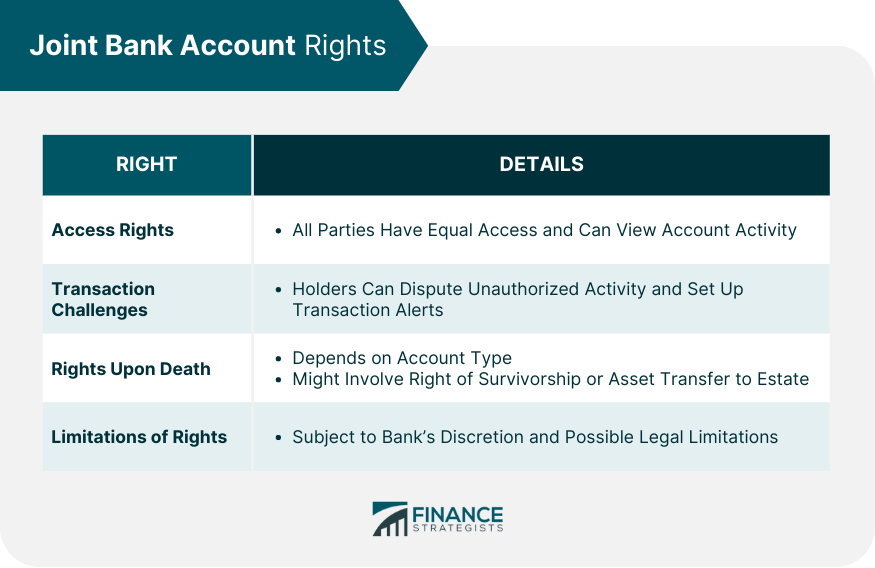
Joint accounts serve diverse financial needs depending on the relationship between account holders and their objectives. Understanding the distinctions between types of joint accounts is essential for selecting the most suitable structure for shared financial management. This section categorizes five primary types of joint accounts, outlines their operational features, and provides scenarios where each is most advantageous, along with a decision matrix to guide selection based on relationship dynamics, legal jurisdiction, and financial goals.
Categorization of Joint Accounts by Structure and Purpose

Joint accounts vary significantly in ownership rights, tax implications, and inheritance rules. The following categories represent the most common types, each tailored to specific financial or relational contexts.
Joint accounts can be broadly classified into five primary types, each with distinct legal and financial characteristics:
- Joint Tenancy Accounts (with Right of Survivorship) - Ownership Structure: Equal ownership among all account holders. Upon the death of one holder, their share automatically transfers to the surviving holders. - Key Features: - Right of Survivorship: Ensures seamless transfer of assets without probate, making it ideal for spouses or long-term partners. - Equal Liability: All holders are equally responsible for debts and transactions. - Taxation: Income is reported jointly, and capital gains/losses are split among survivors. - Common Use Cases: - Married couples or domestic partners managing household finances. - Parents gifting assets to children while retaining control during their lifetime. - Business partners who wish to avoid probate for shared assets. - Example Scenario: A married couple opens a joint tenancy savings account to pool their emergency funds. If one spouse passes away, the surviving spouse inherits full ownership without legal complications.
- Tenants in Common Accounts - Ownership Structure: Unequal ownership shares, allowing each holder to specify their percentage of the account. Shares do not automatically transfer upon death; they pass to heirs as specified in a will. - Key Features: - No Right of Survivorship: Assets are distributed according to individual wills or trusts. - Flexible Contributions: Holders can contribute disproportionately (e.g., one partner contributes 60% while the other contributes 40%). - Taxation: Each holder reports their share of income and capital gains separately. - Common Use Cases: - Investors pooling funds for real estate or business ventures where unequal contributions are expected. - Siblings inheriting a property and wishing to manage funds separately. - Roommates splitting expenses but wanting to retain individual control over assets. - Example Scenario: Two siblings inherit a rental property and open a tenants-in-common account to manage proceeds. Each sibling specifies in their will how their share should be distributed to their own children, avoiding disputes over inheritance.
- Joint Business Accounts - Ownership Structure: Shared ownership among business partners, with contributions and liabilities defined by partnership agreements. - Key Features: - Partnership Agreements: Legal documents outline contribution ratios, profit-sharing, and dispute resolution. - Taxation: Business income is reported on partnership tax returns (e.g., Form 1065 in the U.S.), with profits/losses passed to individual holders. - Liability: Personal assets of partners may be at risk if the business incurs debt, depending on the legal structure (e.g., LLC vs. general partnership). - Common Use Cases: - Startups or small businesses with multiple owners. - Freelancers or consultants collaborating on projects. - Family-owned businesses passing assets to the next generation. - Example Scenario: Three friends launch a tech startup and open a joint business account to fund operations. Their partnership agreement stipulates that profits are split 40%, 30%, and 30%, with each partner’s personal liability limited to their investment unless otherwise agreed.
- Joint Retirement Accounts - Ownership Structure: Shared ownership of retirement funds, such as Individual Retirement Accounts (IRAs) or 401(k)s, typically between spouses. - Key Features: - Spousal IRAs: Non-working spouses can contribute to an IRA based on their partner’s income. - Inherited IRAs: Survivorship rules dictate how funds are transferred to beneficiaries. - Tax-Deferred Growth: Contributions and earnings grow tax-free until withdrawal. - Withdrawal Rules: Joint withdrawals may trigger penalties or tax implications if not managed correctly. - Common Use Cases: - Couples saving for retirement with combined income. - Parents funding retirement accounts for their children (e.g., Coverdell ESAs). - Estate planning to provide tax-advantaged inheritance for heirs. - Example Scenario: A couple opens a joint Roth IRA to maximize contributions. Since both spouses work, they contribute the annual limit for each, benefiting from tax-free growth and withdrawals in retirement.
- Joint Credit Accounts - Ownership Structure: Shared responsibility for credit obligations, such as credit cards, mortgages, or loans. - Key Features: - Authorized Users vs. Joint Holders: Authorized users can make purchases but are not legally liable for debt; joint holders share equal responsibility. - Credit Score Impact: Joint credit accounts can positively or negatively affect both holders’ credit scores based on payment history. - Debt Liability: All joint holders are equally responsible for repaying the full balance. - Common Use Cases: - Married couples building credit history together. - Roommates or partners co-signing a lease or utility bill. - Business partners securing a line of credit for operations. - Example Scenario: A newlywed couple applies for a joint credit card to establish credit and earn rewards. Both are equally responsible for payments, and late fees or missed payments will harm both credit scores.
Joint Account Structures for Specific Relationships
The suitability of a joint account depends heavily on the nature of the relationship between account holders. Below are tailored structures for common relational dynamics, along with scenarios where each is most advantageous.
Selecting the right joint account structure requires aligning the account’s features with the account holders’ goals, legal protections, and potential risks. The following relationships benefit from specific joint account types:
- Spouses or Domestic Partners - Recommended Structures: Joint Tenancy Accounts (with Right of Survivorship) or Tenants in Common (if unequal contributions are desired). - Advantages: - Simplified Estate Planning: Avoids probate and ensures automatic transfer of assets to the surviving spouse. - Tax Benefits: Couples can file joint tax returns, potentially reducing taxable income. - Shared Financial Responsibility: Eases budgeting for shared expenses like mortgages, utilities, and investments. - Scenario: A married couple opens a joint checking account to manage household expenses. They opt for joint tenancy to ensure the surviving spouse inherits the account balance without legal hurdles. Additionally, they open a joint Roth IRA to maximize retirement savings contributions.
- Family Members (Parents and Children, Siblings) - Recommended Structures: Tenants in Common (for unequal contributions) or Joint Tenancy (for equal gifting). - Advantages: - Estate Planning: Parents can gift assets to children while retaining control during their lifetime. - Education Funding: Joint 529 plans or custodial accounts allow families to pool resources for education expenses. - Asset Protection: Parents can protect inheritances from creditors or divorce settlements by structuring accounts appropriately. - Scenario: Parents open a tenants-in-common savings account to save for their children’s college education. Each parent contributes equally, but the account is structured so that each child inherits their parent’s share according to individual wills. This ensures fairness and avoids disputes over inheritance.
- Business Partners - Recommended Structures: Joint Business Accounts with clear partnership agreements. - Advantages: - Operational Efficiency: Streamlines funding for business expenses, payroll, and investments. - Legal Clarity: Partnership agreements define contribution ratios, profit-sharing, and dispute resolution. - Tax Flexibility: Business income and expenses are reported separately, allowing for deductions and credits. - Scenario: Two entrepreneurs launch a marketing agency and open a joint business account. Their partnership agreement specifies that profits are split 60% to the majority investor and 40% to the minority investor. The account is used to pay vendors, salaries, and reinvest in the business. Disputes are resolved through mediation as outlined in their agreement.
- Roommates or Non-Related Shared Housing - Recommended Structures: Tenants in Common Accounts or separate accounts with automated transfers for shared expenses. - Advantages: - Transparency: Clear documentation of contributions and expenses reduces conflicts. - Flexibility: Roommates can opt out without affecting others’ access to funds. - Liability Protection: Separate accounts with designated shared expenses limit personal liability for others’ debts. - Scenario: Three roommates rent a house and open a tenants-in-common account to manage security deposits and shared utilities. Each roommate contributes proportionally based on their
A joint account is more than a financial tool; it is a reflection of the relationships and goals it serves. From simplifying bill payments for roommates to securing multi-generational wealth for families, its structure demands careful planning to align with legal frameworks, tax obligations, and personal dynamics. By understanding the types of joint accounts available, their operational intricacies, and the potential pitfalls—such as shared liability or inheritance complications—individuals can harness their benefits while mitigating risks. Whether you are a couple merging finances, partners launching a business, or parents planning for their children’s future, the key lies in transparency, clear agreements, and a proactive approach to management. Mastering these accounts transforms shared money into a strategic asset, not just a convenience.
Leave a Comment
Comments are moderated before appearing. The data you submit is processed according to the Privacy Policy of Vetlife Archive.