what is a quadrilateral and its geometric significance in math
Table of Contents
- Definition and Core Characteristics of a Quadrilateral
- Fundamental Properties and Mathematical Constraints
- Real-World Applications and Examples
- Classification Based on Side Lengths and Angles
- Types of Quadrilaterals: Classification, Properties, and Geometric Hierarchies
- Comprehensive Classification of Quadrilaterals
- Parallelograms: The Foundational Quadrilateral
- Rectangles, Rhombuses, and Squares: Specialized Parallelograms
- Geometric Properties and Theorems Associated with Quadrilaterals
- Sum of Interior Angles in Quadrilaterals and Proof via Triangle Division
- Properties of Diagonals in Special Quadrilaterals
- Symmetry in Quadrilaterals: Line and Rotational Symmetry
- Calculating Area of Quadrilaterals: Formulas and Methods
- Interactive Quadrilateral Calculator: HTML Table for Area and Perimeter
- Applications of Quadrilaterals in Mathematics, Science, and Daily Life
- Quadrilaterals in Coordinate Geometry and Cartesian Plane Representations
- Computer Graphics and Game Design: Modeling and Tessellation
- Structural Engineering and Physics: Forces and Material Stress
- Urban Planning and Architectural Design
- Quadrilaterals in Nature: Crystals, Cells, and Botanical Structures
- Case Study: The Parthenon’s Geometric Precision
- Advanced Topics: Special Quadrilaterals and Extensions in Geometric Exploration
- Cyclic Quadrilaterals: Inscribed Angles and Brahmagupta’s Formula
- Tangential Quadrilaterals and Islamic Geometric Art
- Orthodiagonal Quadrilaterals: Diagonal Perpendicularity and Kite Relationships
- Skew Quadrilaterals: Non-Planar Extensions in Three-Dimensional Space
- Historical Evolution: From Euclid to Computational Geometry
- Comparative Analysis: Euclidean vs. Non-Euclidean Quadrilaterals
- Interactive Learning and Problem-Solving with Quadrilaterals
- Step-by-Step Geometric Proofs of Quadrilateral Properties
- Problem-Solving Challenges by Difficulty Level
- Pedagogical Strategies for Teaching Quadrilaterals
- Artistic and Design Applications of Quadrilaterals
- Addressing Common Misconceptions About Quadrilaterals
- Quadrilateral Puzzles and Brain Teasers
Geometry’s simplest yet most versatile shapes often define the world around us, and few embody this better than the quadrilateral. A four-sided polygon found in everything from architectural marvels to everyday objects, its definition extends far beyond basic school lessons—shaping everything from structural engineering to digital design. At its core, a quadrilateral is a closed figure with four straight sides, four vertices, and interior angles totaling 360 degrees, yet its variations—parallelograms, trapezoids, rhombuses—unlock deeper mathematical truths and practical applications that influence industries and nature alike.
The study of quadrilaterals bridges abstract theory and real-world functionality, revealing how geometric principles govern stability in bridges, precision in computer graphics, and even the symmetry of crystalline structures. Whether dissecting the properties of a square’s perfect angles or exploring the irregularity of a kite’s diagonals, each type offers a unique lens into spatial relationships. From ancient Greek mathematicians to modern architects, the quadrilateral remains a cornerstone of problem-solving, proving that even the most fundamental shapes hold layers of complexity waiting to be uncovered.

Definition and Core Characteristics of a Quadrilateral

A quadrilateral stands as a cornerstone of Euclidean geometry, representing a four-sided polygon whose study bridges foundational mathematics with practical applications in architecture, engineering, and design. Unlike simpler polygons such as triangles or more complex ones like pentagons, quadrilaterals introduce a balance of flexibility and rigidity, making them essential for analyzing shapes in both theoretical and real-world contexts. Their defining properties—four sides, four vertices, and four interior angles—create a framework for classifying diverse shapes, from the symmetrical rectangles in skyscrapers to the irregular trapezoids in road signs.
The geometric constraints of quadrilaterals ensure they remain closed, planar figures with straight, non-intersecting edges, distinguishing them from open curves or self-intersecting polygons. Their interior angles sum to 360°, a defining characteristic that sets them apart from triangles (180°) and pentagons (540°). This section explores the mathematical and physical properties of quadrilaterals, their classification based on side lengths and angles, and their ubiquitous presence in everyday objects.
Fundamental Properties and Mathematical Constraints
Quadrilaterals are defined by four fundamental properties that distinguish them from other polygons: 1. Four sides (edges): Each side is a straight line segment connecting two vertices, ensuring the shape remains a closed loop. 2. Four vertices (corners): The points where two sides meet, determining the shape’s angular structure. 3. Four interior angles: The angles formed at each vertex, which collectively sum to 360°, derived from the formula for the sum of interior angles of an n-sided polygon: (n – 2) × 180°. 4. Planar and simple: Quadrilaterals lie entirely in a single plane and do not intersect themselves, unlike complex polygons like star-shaped pentagons.
Sum of Interior Angles Formula: For any n-sided polygon, the sum of interior angles = (n – 2) × 180°. For quadrilaterals (n = 4): (4 – 2) × 180° = 360°.
A comparison table below illustrates how quadrilaterals differ from triangles and pentagons in terms of sides, angles, and geometric constraints:
| Property | Triangle | Quadrilateral | Pentagon |
|---|---|---|---|
| Number of Sides | 3 | 4 | 5 |
| Sum of Interior Angles | 180° | 360° | 540° |
| Minimum Side Lengths for Closure | 3 sides (triangle inequality theorem) | 4 sides (no strict minimum, but sides must connect sequentially) | 5 sides |
| Convexity | Always convex | Can be convex or concave | Can be convex or concave |
| Real-World Examples | Pyramid base, slice of pizza | Doors, windows, tables, books | House roofs, stop signs (regular pentagon) |
The constraints of quadrilaterals—such as the requirement for sides to connect end-to-end without intersecting—ensure their stability in structural applications. For instance, a tabletop (often a rectangle) distributes weight evenly due to its four-sided symmetry, while a kite (a concave quadrilateral) relies on its irregular angles for aerodynamic lift.
Real-World Applications and Examples
Quadrilaterals permeate everyday life, often serving functional or aesthetic purposes. Their versatility stems from their ability to adapt to various side lengths and angle configurations, making them ideal for both static and dynamic structures. Below are key examples categorized by their geometric properties:
- Rectangles and Squares (Equilateral and Equiangular Quadrilaterals) Rectangles and squares dominate architecture and design due to their stability and ease of construction. A rectangle features four right angles (90°) and opposite sides of equal length, such as in:
- Doors and windows: Frames are typically rectangular to maximize space efficiency and structural integrity.
- Computer monitors and smartphones: Displays often use rectangular or square aspect ratios for optimal viewing angles.
- Floor tiles: Square tiles create uniform patterns, while rectangular tiles allow for elongated designs in bathrooms or kitchens.
- Parallelograms (Opposite Sides Parallel and Equal) Parallelograms include rhombuses and rectangles, where both pairs of opposite sides are parallel and equal in length. Examples include:
- Bricks and tiles: Often laid in parallelogram patterns to create herringbone or staggered designs.
- Slide rules and some musical instruments: The shape allows for precise measurements or sound modulation.
- Certain types of kites: While traditionally diamond-shaped (rhombus), some modern designs use parallelogram frameworks for stability.
- Trapezoids (At Least One Pair of Parallel Sides) Trapezoids appear in objects requiring non-parallel sides for functionality, such as:
- Road signs and traffic cones: Often trapezoidal to improve visibility and reduce wind resistance.
- Tents and canopies: Some designs use trapezoidal panels to distribute weight and tension evenly.
- Staircases: The steps themselves may form a trapezoidal cross-section, optimizing space in tight corridors.
- Concave Quadrilaterals (At Least One Interior Angle > 180°) Concave quadrilaterals, such as dart-shaped figures or chevrons, are less common but serve niche purposes:
- Arrowheads and dartboards: The concave angle creates a pointed tip for precision.
- Certain types of gears and mechanical linkages: Irregular angles allow for specific motion paths in machinery.
- Art and sculpture: Concave shapes add visual interest, such as in abstract paintings or architectural facades.
Property of Rectangles: Opposite sides are equal and parallel, and all interior angles are 90°. Diagonals bisect each other and are of equal length.
The adaptability of quadrilaterals extends to natural phenomena, such as the four-season cycle (modeled as a quadrilateral in some climate diagrams) or the cross-sectional shapes of certain crystals, where angles and side lengths influence physical properties like hardness or cleavage.
Classification Based on Side Lengths and Angles
Quadrilaterals are categorized into distinct types based on the lengths of their sides and the measures of their angles. This classification system is critical for identifying geometric relationships and solving problems in fields like computer graphics, physics, and engineering. The flowchart below outlines the primary classifications, while the subsequent discussion elaborates on convexity, side equality, and angle properties.
Quadrilaterals are broadly divided into two categories: 1. Convex Quadrilaterals: All interior angles are less than 180°, and the vertices point outward. Examples include squares, rectangles, and parallelograms. 2. Concave Quadrilaterals: At least one interior angle exceeds 180°, creating an "indent" in the shape. Examples include dart shapes and some arrowheads.
Within these categories, further classification depends on: - Side length equality: Are sides of equal length (equilateral) or unequal? - Angle measures: Are angles equal (equiangular) or varied? - Parallel sides: Are opposite sides parallel, or only one pair?
The following structured flowchart (described textually for clarity) illustrates the decision-making process for classifying quadrilaterals:
Flowchart for Quadrilateral Classification: 1. Start: Is the quadrilateral convex or concave?
Convex: Proceed to Step 2. Concave: Classify Types of Quadrilaterals: Classification, Properties, and Geometric Hierarchies
Quadrilaterals form one of the most diverse and widely studied categories in Euclidean geometry, with each type exhibiting unique properties that influence their application in architecture, engineering, and design. Their classification is based on the relationships between sides, angles, and diagonals, creating a structured hierarchy that begins with the foundational parallelogram and branches into specialized forms like rectangles, rhombuses, and trapezoids. Understanding these distinctions allows mathematicians, designers, and engineers to select the appropriate quadrilateral for structural stability, aesthetic symmetry, or functional efficiency. Below is a systematic breakdown of quadrilateral types, their defining characteristics, and their interrelations, followed by practical methods for identification and construction.
Comprehensive Classification of Quadrilaterals
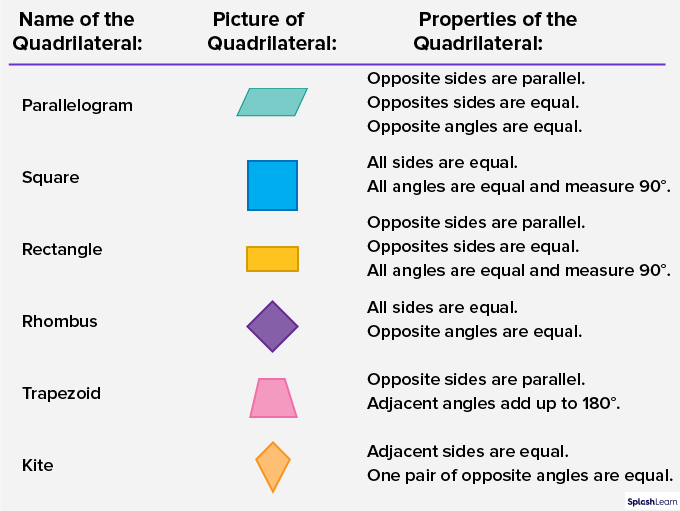
The following table summarizes the primary types of quadrilaterals, their defining properties, and real-world examples. Each category adheres to specific rules regarding side lengths, angles, and diagonals, which collectively determine their geometric behavior.
Name Defining Properties Side Length Rules Angle Rules Diagonal Properties Examples Parallelogram Opposite sides parallel and equal in length; opposite angles equal. Opposite sides equal (AB = CD, AD = BC). Opposite angles equal (∠A = ∠C, ∠B = ∠D); consecutive angles supplementary (∠A + ∠B = 180°). Diagonals bisect each other but are not necessarily equal. Floor tiles, integrated circuit layouts, structural beams. Rectangle Specialized parallelogram with four right angles. Opposite sides equal (AB = CD, AD = BC). All four angles are 90°. Diagonals equal in length and bisect each other. Windows, doors, computer monitors, chessboards. Rhombus Specialized parallelogram with all sides equal. All four sides equal (AB = BC = CD = DA). Opposite angles equal; consecutive angles supplementary. Diagonals bisect each other at right angles and are not equal in length unless it is a square. Kite frames, diamond-shaped jewelry, certain roof trusses. Square Specialized parallelogram combining properties of rectangles and rhombuses (all sides equal, all angles 90°). All four sides equal. All four angles are 90°. Diagonals equal in length, bisect each other at right angles, and are the longest diagonals possible in a quadrilateral with given side lengths. Chessboard squares, floor tiles, stop signs (octagonal but composed of squares). Trapezoid (Trapezium) At least one pair of parallel sides (inclusive definition); exactly one pair of parallel sides (exclusive definition). Only one pair of sides parallel (AB ∥ CD). Consecutive angles between parallel sides are supplementary. Diagonals do not necessarily bisect each other. Tables, certain bridges, architectural facades, modern building roofs. Isosceles Trapezoid Non-parallel sides (legs) are equal in length; base angles equal. Non-parallel sides equal (AD = BC); parallel sides unequal. Base angles equal (∠A = ∠B, ∠C = ∠D); consecutive angles supplementary. Diagonals equal in length. Ladder rungs, certain types of tables, decorative moldings. Kite Two distinct pairs of adjacent sides equal; one diagonal bisected by the other. Two pairs of adjacent sides equal (AB = AD, CB = CD). One pair of opposite angles equal (∠B = ∠D). One diagonal bisected by the other; longer diagonal bisects the shorter. Traditional kites, certain types of wind turbines, decorative patterns. Irregular Quadrilateral No sides parallel; no equal sides or angles. All sides and angles unequal. No specific angle rules. Diagonals unequal and do not bisect each other. Randomly shaped signs, certain abstract art designs. Parallelograms: The Foundational Quadrilateral
Parallelograms serve as the cornerstone of quadrilateral classification due to their balanced properties, where opposite sides are both parallel and equal in length, and opposite angles are congruent. These characteristics ensure structural symmetry, making parallelograms ideal for applications requiring stability and predictable geometric behavior. The defining properties of a parallelogram include:
Opposite sides parallel and equal: If sides AB and CD are parallel and equal, and sides AD and BC are parallel and equal, the figure is a parallelogram. Opposite angles equal: Angles ∠A and ∠C are equal, as are ∠B and ∠D. Consecutive angles supplementary: The sum of adjacent angles (e.g., ∠A + ∠B) equals 180°, ensuring perpendicularity in derived shapes like rectangles. Diagonals bisect each other: The point where diagonals AC and BD intersect divides them into equal segments. Parallelograms act as a template for more specialized quadrilaterals. For instance, rectangles introduce the constraint of four right angles, while rhombuses enforce equal side lengths. A square merges these constraints, resulting in a shape that is both equilateral and equiangular. This hierarchical relationship underscores the efficiency of parallelograms in geometric proofs and real-world applications, where their properties can be extended or modified to suit specific needs.
Rectangles, Rhombuses, and Squares: Specialized Parallelograms
While all rectangles, rhombuses, and squares are parallelograms, each possesses unique attributes that distinguish them in both theoretical and practical contexts.
Rectangles are defined by their right angles (90°) and equal opposite sides. Their diagonals are equal in length and bisect each other, a property exploited in construction to ensure alignment and stability. Examples include door frames and computer screens, where right angles are essential for functionality. A rectangle with sides of length a and b has diagonals of length √(a² + b²), derived from the Pythagorean theorem.
Rhombuses feature four equal sides and diagonals that intersect at right angles, dividing the shape into four congruent right-angled triangles. This property is leveraged in designs requiring symmetrical tension, such as kite frames or certain types of roof trusses. Unlike rectangles, rhombuses do not inherently have right angles unless they are squares. The area of a rhombus can be calculated using the formula: (d₁ × d₂)/2, where d₁ and d₂ are the lengths of the diagonals.
Squares represent the convergence of rectangle and rhombus properties, combining four equal sides with four right angles. Their diagonals are equal in length, bisect each other at 90°, and are the longest possible diagonals for a given side length. Squ Geometric Properties and Theorems Associated with Quadrilaterals
Quadrilaterals serve as fundamental building blocks in geometry, bridging simple polygons and complex geometric figures. Their properties—ranging from angle sums to diagonal behaviors—form the basis for theorems that apply across architecture, engineering, and computer graphics. Understanding these geometric principles not only clarifies the structure of quadrilaterals but also enables practical calculations, such as area determination and symmetry analysis. Below are the key theorems, proofs, and properties that define quadrilaterals mathematically and visually.
Sum of Interior Angles in Quadrilaterals and Proof via Triangle Division
The sum of the interior angles of any quadrilateral is 360°, a universal property that distinguishes them from triangles (180°) and pentagons (540°). This invariant arises from the quadrilateral’s ability to be partitioned into two triangles, each contributing 180° to the total. Proof Using Triangle Division: 1. Draw one diagonal of the quadrilateral, dividing it into two triangles. 2. The sum of angles in each triangle is 180°, so the combined sum for both triangles is 360°. 3. Since the diagonal does not alter the original quadrilateral’s angles, the total remains 360° regardless of the quadrilateral’s shape or side lengths.
Formula: For any convex quadrilateral with interior angles A, B, C, and D: A + B + C + D = 360°
This theorem holds true for all quadrilaterals, including concave shapes, provided the angles are measured correctly (using exterior angles if necessary). The proof’s simplicity underscores the elegance of geometric decomposition.
Properties of Diagonals in Special Quadrilaterals
Diagonals in quadrilaterals exhibit distinct behaviors depending on the figure’s type, influencing stability, symmetry, and calculative properties. Below are the defining characteristics: 1. Parallelograms In parallelograms, diagonals bisect each other, meaning they intersect at their midpoints. This property is critical for proving congruence and calculating unknown side lengths. For example, if diagonal d₁ divides the parallelogram into two congruent triangles, the opposite sides remain parallel and equal in length. 2. Rectangles and Isosceles Trapezoids Rectangles feature diagonals of equal length, a consequence of the Pythagorean theorem applied to their right angles. In an isosceles trapezoid, diagonals are also equal, reflecting the trapezoid’s symmetrical base structure. 3. Rhombuses and Squares Rhombuses have diagonals that intersect at 90° and bisect each other, dividing the figure into four right-angled triangles. Squares inherit these properties while adding equal diagonal lengths, reinforcing their dual classification as both rectangles and rhombuses.
Key Property: For a rhombus with diagonals d₁ and d₂:
Diagonals are perpendicular (d₁ ⊥ d₂). Each diagonal bisects the angles of the rhombus. Area = (d₁ × d₂) / 2. Understanding diagonal properties is essential for constructing proofs, designing structures, and solving geometric puzzles where quadrilaterals are central.
Symmetry in Quadrilaterals: Line and Rotational Symmetry
Symmetry in quadrilaterals enhances their aesthetic and functional applications, from tiling patterns to mechanical designs. Line symmetry (reflectional) and rotational symmetry define how a quadrilateral can be divided or rotated while retaining identical appearance. Case Studies:
Rectangles: Possess two lines of symmetry (vertical and horizontal through the center) and 180° rotational symmetry. This dual symmetry allows rectangles to tile planes seamlessly. Rhombuses: Exhibit two lines of symmetry (along the diagonals) and 180° rotational symmetry, enabling them to form intricate lattice structures. Squares: Combine the properties of rectangles and rhombuses, featuring four lines of symmetry (diagonals and midlines) and 90°, 180°, 270°, and 360° rotational symmetry. Their high symmetry makes squares ideal for foundational layouts in architecture. Symmetry Classification:
Line Symmetry: Number of axes a figure can be reflected over without changing its appearance. Rotational Symmetry: Smallest angle of rotation (≤180°) that maps the figure onto itself. Symmetry analysis is pivotal in fields like crystallography and computer graphics, where quadrilateral-based patterns must repeat predictably.
Calculating Area of Quadrilaterals: Formulas and Methods
Area calculation for quadrilaterals varies by shape, requiring tailored approaches based on available measurements. Below are step-by-step methods for common quadrilaterals, emphasizing practicality and formula derivation. 1. Trapezoids (Including Parallelograms and Rectangles) Use the base-height formula:
Formula: Area = (a + b) × h / 2 Where:
a and b = lengths of the two parallel sides (bases). h = height (perpendicular distance between bases). Steps: 1. Identify the two parallel sides (a and b). 2. Measure the perpendicular height (h) between them. 3. Plug values into the formula. Example: A trapezoid with bases 8 cm and 5 cm, and height 4 cm: Area = (8 + 5) × 4 / 2 = 26 cm². 2. Rhombuses and Kites Use the diagonal division method:
Formula: Area = (d₁ × d₂) / 2 Where d₁ and d₂ = lengths of the diagonals.
Steps: 1. Measure both diagonals (d₁ and d₂). 2. Multiply and divide by 2. Example: A rhombus with diagonals 6 cm and 8 cm: Area = (6 × 8) / 2 = 24 cm². 3. General Quadrilaterals (Using Bretschneider’s or Brahmagupta’s Formula) For irregular quadrilaterals, use Bretschneider’s formula (when sides and two opposite angles are known):
Formula: Area = √[((s − a)(s − b)(s − c)(s − d)) − (ab + cd)*cos²(θ/2)] Where:
s = semiperimeter = (a + b + c + d) / 2. θ = sum of two opposite angles. For cyclic quadrilaterals (inscribed in a circle), Brahmagupta’s formula simplifies to:
Formula: Area = √[(s − a)(s − b)(s − c)(s − d)]
Interactive Quadrilateral Calculator: HTML Table for Area and Perimeter
Below is a conceptual HTML table designed to compute the area and perimeter of quadrilaterals based on user inputs. The table dynamically applies formulas tailored to the selected quadrilateral type, ensuring accuracy and educational clarity.
Quadrilateral Calculator
Quadrilateral Type Input Parameters Formula Applied Result Rectangle Length (a) Perimeter = 2(a + b)Area = a × b cm Width (b) cm Calculate Area: -- cm² | Perimeter: -- cm Output updates dynamically. Trapezoid Base 1 (a) Applications of Quadrilaterals in Mathematics, Science, and Daily Life
Quadrilaterals transcend theoretical geometry, embedding themselves into the fabric of mathematics, technology, and real-world systems. From the precise calculations of coordinate geometry to the structural integrity of architectural marvels, their versatility underscores their fundamental role. This section explores how quadrilaterals function as critical tools in diverse fields, from digital simulations to natural phenomena, demonstrating their adaptability and enduring relevance.
Quadrilaterals in Coordinate Geometry and Cartesian Plane Representations
Coordinate geometry leverages quadrilaterals to model spatial relationships, enabling calculations of slopes, areas, and equations essential for graphing and analysis. On a Cartesian plane, quadrilaterals like rectangles and parallelograms—particularly those aligned with the axes—simplify computations due to their predictable side orientations. Plotting and Equation Determination To plot a quadrilateral, such as a rectangle with vertices at (2, 3), (2, 7), (6, 7), and (6, 3), the horizontal and vertical sides align with the x- and y-axes, respectively. The slope between any two adjacent vertices is either 0 (horizontal) or undefined (vertical). The equation of the sides can be derived using the slope-intercept form (y = mx + b), where m is the slope and b is the y-intercept. For instance, the top side from (2, 7) to (6, 7) has the equation y = 7, while the right side from (6, 3) to (6, 7) is x = 6. Key Formulas for Quadrilateral Analysis
Slope between two points (x₁, y₁) and (x₂, y₂): m = (y₂ – y₁) / (x₂ – x₁) Area of a rectangle: A = length × width Midpoint of a diagonal: M = ((x₁ + x₂)/2, (y₁ + y₂)/2) These principles extend to trapezoids and rhombuses, where non-axis-aligned sides require more complex slope calculations. For example, a rhombus centered at the origin with vertices at (1, 2), (3, 0), (1, –2), and (–1, 0) demands solving for slopes like m = (0 – 2) / (3 – 1) = –1 for one of its sides.
Computer Graphics and Game Design: Modeling and Tessellation
Quadrilaterals serve as foundational elements in computer graphics, where they facilitate the rendering of 2D and 3D environments through polygon meshes and texturing. Their simplicity allows efficient processing, making them ideal for real-time applications like video games and animations. 2D Shape Modeling and Tiling In game design, quadrilaterals form the basis of sprite sheets—collections of 2D images used to animate characters or objects. For instance, a character’s walking cycle might be composed of rectangular sprites arranged in a grid. Additionally, tiling patterns rely on quadrilaterals to create seamless backgrounds or floors. A common example is the grid-based tile map, where rectangles or squares repeat to form infinite landscapes without visible seams. Texture Mapping and Procedural Generation Textures applied to 3D models often use quadrilateral UV mapping, where a 2D quadrilateral (UV space) is projected onto a 3D surface. This technique is critical in games like Minecraft, where cubic blocks are rendered using textured quadrilaterals. Procedural generation algorithms, such as those in No Man’s Sky, employ quadrilateral-based tessellation to create vast, unique planetary terrains dynamically.
Structural Engineering and Physics: Forces and Material Stress
The stability of structures hinges on the distribution of forces, where quadrilaterals—particularly in the form of trusses and frames—optimize load-bearing efficiency. Engineers exploit their geometric properties to minimize material usage while maximizing strength, a principle evident in bridges, skyscrapers, and aircraft frames. Trusses and Stress Analysis A truss is a structural system composed of straight quadrilateral or triangular members connected at joints, designed to carry loads via tension or compression. For example, the Howe truss, used in railway bridges, features a series of vertical and diagonal quadrilateral sections that distribute weight evenly. The method of joints in physics analyzes forces at each node, where the equilibrium of forces in quadrilateral frameworks ensures stability. The formula for equilibrium at a joint is:
ΣFₓ = 0 (sum of horizontal forces) ΣFᵧ = 0 (sum of vertical forces)
Bridges and Beam Design Quadrilaterals appear in box girder bridges, where rectangular or trapezoidal cross-sections resist bending and torsional stresses. The Golden Gate Bridge, for instance, uses a quadrilateral-based suspension system where cables transfer loads to vertical quadrilateral towers. Finite element analysis (FEA) models these structures using quadrilateral mesh elements to simulate stress distribution under various loads.
Urban Planning and Architectural Design
Architecture and urban planning frequently utilize quadrilaterals to maximize space, aesthetics, and functionality. From the modularity of floor plans to the decorative tessellations in mosques, their geometric precision ensures both practicality and visual appeal. Floor Plans and Space Optimization Rectangular and square layouts dominate residential and commercial buildings due to their efficiency in partitioning space. For example, the Le Corbusier’s Modulor system uses golden ratio proportions within quadrilateral modules to create harmonious, scalable designs. Open-plan offices often employ rectangular grids to facilitate flexible layouts, while circulation paths (hallways, staircases) are designed using quadrilateral corridors for ease of movement. Tessellations in Decorative and Functional Design Tessellations—repetitive patterns of quadrilaterals—appear in Islamic art, where star polygons and geometric mosaics adorn walls and domes. The Alhambra’s Court of the Lions features intricate tilings of squares, octagons, and rectangles, demonstrating how quadrilaterals create complex, seamless designs. In modern architecture, metallic cladding on skyscrapers, such as the Burj Khalifa, uses quadrilateral panels to reflect light and reduce wind loads.
Quadrilaterals in Nature: Crystals, Cells, and Botanical Structures
Nature occasionally mirrors geometric ideals, with quadrilaterals emerging in crystalline formations, cellular biology, and plant morphology. While many natural shapes are irregular, their underlying symmetry often approximates quadrilateral frameworks. Crystal Lattices and Mineral Formation Crystals grow in polyhedral shapes, many of which include quadrilateral faces. For example, gypsum forms orthorhombic crystals with rectangular and parallelogram faces, while calcite exhibits rhombohedral structures with quadrilateral cross-sections. The Bravais lattice in crystallography describes atomic arrangements, where unit cells—often quadrilateral-based—repeat to form macroscopic structures. Cellular and Botanical Examples Certain animal cells, like those in honeycomb structures (e.g., bee cells), approximate hexagonal tilings, but quadrilateral patterns appear in leaf venation and stem arrangements. The phyllotaxis of plants, such as the Fibonacci spiral in sunflower heads, often involves quadrilateral sub-patterns when observed at specific growth stages. Additionally, dragonfly wings exhibit a network of veins forming quadrilateral cells, optimizing strength and flight efficiency.
Case Study: The Parthenon’s Geometric Precision
The Parthenon, an ancient Greek temple on the Acropolis of Athens, exemplifies how quadrilaterals contribute to both structural integrity and aesthetic harmony. Designed by Iktinos and Kallikrates in the 5th century BCE, its rectangular floor plan (69.5m × 30.9m) and optical refinements demonstrate an advanced understanding of quadrilateral geometry. Optical Corrections and Quadrilateral Alignment The Parthenon’s columns are not perfectly straight but exhibit entasis—a slight convex curvature—to counteract the optical illusion of concavity. The temple’s stereobate (foundation) is a series of three rectangular steps, each aligned with quadrilateral precision. The frieze at the top features a continuous Doric procession, where the metopes (square quadrilaterals) and triglyphs create a rhythmic pattern that enhances the structure’s visual stability. Stability Through Quadrilateral Framing The peristyle (columnar surround) forms a quadrilateral perimeter, distributing the weight of the marble roof evenly. The caryatids (female statues) on the Ere
Advanced Topics: Special Quadrilaterals and Extensions in Geometric Exploration
Quadrilaterals extend beyond basic classifications into specialized forms that challenge conventional geometric assumptions and reveal deeper mathematical relationships. These advanced configurations—cyclic, tangential, orthodiagonal, and skew quadrilaterals—demonstrate how quadrilaterals adapt to three-dimensional spaces, non-Euclidean geometries, and historical problem-solving frameworks. Their study bridges theoretical mathematics with practical applications in architecture, computational design, and even cultural artistry, particularly in Islamic geometric tiling. This section explores their defining properties, historical significance, and comparative behaviors across geometric systems, emphasizing how they redefine the boundaries of quadrilateral analysis.
Cyclic Quadrilaterals: Inscribed Angles and Brahmagupta’s Formula
A cyclic quadrilateral is a four-sided polygon whose vertices all lie on a single circle, a condition that imposes strict constraints on its angles and sides. The defining property of cyclic quadrilaterals is that the sum of each pair of opposite angles equals 180°, a direct consequence of the Inscribed Angle Theorem. This relationship ensures that if one angle is acute, its opposite must be obtuse, creating a balance that distinguishes cyclic quadrilaterals from arbitrary four-sided figures. The area of a cyclic quadrilateral can be calculated using Brahmagupta’s formula, an extension of Heron’s formula for triangles:
Area = √((s − a)(s − b)(s − c)(s − d)) where s is the semiperimeter (s = (a + b + c + d)/2), and a, b, c, d are the side lengths.
This formula, derived by the 7th-century Indian mathematician Brahmagupta, highlights the elegance of cyclic quadrilaterals in computational geometry. Practical applications include optimizing the design of greenhouse roofs, architectural domes, and solar panel arrangements, where maximizing area under perimeter constraints is critical.
Tangential Quadrilaterals and Islamic Geometric Art
Unlike cyclic quadrilaterals, which are inscribed in a circle, tangential quadrilaterals possess an incircle—a circle tangent to all four sides. This unique property requires that the sums of the lengths of opposite sides are equal (a + c = b + d), a condition known as Pitot’s Theorem. Tangential quadrilaterals are foundational in Islamic geometry, where they form the basis for intricate tiling patterns in mosques, palaces, and manuscripts, such as those in the Alhambra (Granada, Spain) or the Topkapı Palace (Istanbul, Turkey). The interplay between cyclic and tangential quadrilaterals leads to bicentric quadrilaterals, which satisfy both conditions simultaneously. These shapes are rare and studied for their aesthetic and mathematical symmetry. In modern applications, tangential quadrilaterals influence packaging design, fractal geometry, and 3D-printed structures, where efficient space-filling and minimal surface contact are prioritized.
Orthodiagonal Quadrilaterals: Diagonal Perpendicularity and Kite Relationships
An orthodiagonal quadrilateral is defined by diagonals that intersect at 90°, a property shared by rhombuses and squares but extended to more general shapes like kites and orthodiagonal trapezoids. The area of such quadrilaterals simplifies to half the product of their diagonal lengths:
Area = (1/2) × d₁ × d₂
This relationship is exploited in engineering, particularly in the design of bridge trusses and roof frameworks, where diagonal bracing ensures structural stability. Orthodiagonal quadrilaterals also appear in computer graphics as efficient meshing tools for curved surfaces, reducing computational complexity in rendering. A subset of orthodiagonal quadrilaterals, equidiagonal quadrilaterals, have diagonals of equal length. These shapes exhibit unique symmetry and are studied in crystallography to model atomic lattice structures.
Skew Quadrilaterals: Non-Planar Extensions in Three-Dimensional Space
While traditional quadrilaterals lie in a single plane, skew quadrilaterals exist in three-dimensional space with vertices not coplanar, forming a tetrahedral framework. Unlike planar quadrilaterals, skew quadrilaterals lack consistent angle or side-sum properties, but their study is vital in molecular chemistry (e.g., modeling carbon ring structures) and computer-aided design (CAD) for parametric modeling. In 3D printing, skew quadrilaterals enable the creation of non-planar surfaces, such as hyperbolic paraboloids, used in modern architecture like the Sydney Opera House. The distinction between planar and skew quadrilaterals underscores the limitations of two-dimensional geometry in describing real-world phenomena, particularly in robotics and aerospace engineering, where non-planar motion paths are common.
Historical Evolution: From Euclid to Computational Geometry
The study of quadrilaterals traces back to Euclid’s Elements (c. 300 BCE), where propositions on parallelograms and trapezoids laid the groundwork for systematic geometric proof. Later, Al-Khwarizmi (9th century), a Persian mathematician, expanded quadrilateral analysis in his work on algebra and geometric constructions, influencing Islamic scholars who refined tiling techniques. The Renaissance saw quadrilaterals applied to perspective drawing, while the 19th century introduced non-Euclidean geometries, challenging the assumption that quadrilateral angle sums must total 360°. In the 20th and 21st centuries, computational geometry revolutionized quadrilateral studies. Leonardo da Vinci’s sketches of dynamic quadrilateral linkages foreshadowed modern kinematic analysis, while Bézier curves (used in CAD software) rely on quadrilateral-based control points. Today, researchers in discrete differential geometry explore quadrilateral meshes for surface reconstruction in medical imaging and virtual reality environments.
Comparative Analysis: Euclidean vs. Non-Euclidean Quadrilaterals
Quadrilateral properties diverge significantly in non-Euclidean geometries, where the parallel postulate of Euclidean space no longer applies. The following table contrasts key attributes:
In spherical geometry, quadrilaterals appear as spherical polygons (e.g., on globes or celestial spheres), where the angle sum exceeds 360° due to curvature. Conversely,
Property Euclidean Geometry Spherical Geometry Hyperbolic Geometry Angle Sum of Quadrilateral Always 360° Greater than 360° (excess depends on area) Less than 360° (deficit depends on area) Parallel Lines Two lines cut by a transversal have corresponding angles summing to 180° No parallel lines; all great circles intersect Infinitely many parallels through a point; ultraparallels diverge Cyclic Quadrilateral Condition Opposite angles sum to 180° Opposite angles sum to >180°; no true "circle" exists Opposite angles sum to <180°; "circles" are horocycles Area Calculation Brahmagupta’s formula (for cyclic); Shoelace formula (general) Excess angle area formula (A = (θ₁ + θ₂ + θ₃ + θ₄ − 360°) × R²) Defect area formula (A = (360° − (θ₁ + θ₂ + θ₃ + θ₄)) × R²) Examples Rectangles, trapezoids, rhombuses Lune-shaped quadrilaterals on spheres (e.g., Earth’s map projections) Poincaré disk models; ideal quadrilaterals in hyperbolic space Interactive Learning and Problem-Solving with Quadrilaterals
Exploring quadrilaterals through interactive methods enhances comprehension, retention, and engagement, transforming abstract geometric concepts into tangible experiences. Problem-solving activities, hands-on experiments, and creative applications bridge the gap between theoretical knowledge and practical understanding. This section integrates structured proofs, tiered problem sets, pedagogical strategies, artistic applications, and critical misconception clarifications to foster deeper geometric intuition and spatial reasoning.Step-by-Step Geometric Proofs of Quadrilateral Properties
Geometric proofs provide a rigorous foundation for understanding quadrilateral properties, reinforcing logical reasoning and deductive skills. Below are two foundational proofs with clear, sequential explanations. Proof: Diagonals of a Rhombus Bisect Each Other at Right Angles A rhombus is defined as a quadrilateral with all sides equal in length. To prove its diagonals bisect each other perpendicularly, follow these steps: 1. Define the Rhombus and Diagonals Let ABCD be a rhombus with diagonals AC and BD intersecting at point O. By definition, AB = BC = CD = DA. 2. Triangles Formed by Diagonals The diagonals divide the rhombus into four triangles: AOB, BOC, COD, and DOA. Since all sides of the rhombus are equal, AB = BC = CD = DA. 3. Congruency of Triangles Consider triangles AOB and COD:AB = CD (sides of the rhombus). AO = CO and BO = DO (diagonals bisect each other, a property of parallelograms, of which rhombuses are a subset). By the Side-Side-Side (SSS) Congruence Criterion, △AOB ≅ △COD. 4. Angle Congruency and Perpendicularity Since the triangles are congruent, corresponding angles are equal. Specifically, ∠AOB = ∠COD. Similarly, △AOD ≅ △BOC, leading to ∠AOD = ∠BOC. Given that ∠AOB and ∠AOD are adjacent and form a linear pair (180°), and they are equal, each must be 90°. Thus, the diagonals intersect at right angles.Key Insight: The proof leverages congruency and the properties of parallelograms to establish perpendicularity, demonstrating how specialized quadrilaterals inherit and extend foundational geometric principles.Problem-Solving Challenges by Difficulty Level
Problem-solving reinforces quadrilateral properties while developing analytical skills. Below are categorized challenges with detailed solutions, progressing from foundational to advanced. Beginner: Calculating Unknown Angles in a Parallelogram Problem: In parallelogram EFGH, ∠E = 65°. Determine the measures of ∠F, ∠G, and ∠H. Solution:Opposite angles in a parallelogram are equal: ∠E = ∠G = 65°. Consecutive angles are supplementary: ∠E + ∠F = 180° → ∠F = 115°. By symmetry, ∠H = ∠F = 115°. Intermediate: Area of a Kite Using Diagonals Problem: A kite has diagonals d₁ = 12 cm and d₂ = 8 cm. Calculate its area. Solution: The area A of a kite is given by:Formula: A = (d₁ × d₂) / 2 Substituting values: A = (12 × 8) / 2 = 48 cm².Advanced: Proving a Quadrilateral is Cyclic Problem: Quadrilateral PQRS has ∠P + ∠R = 180° and ∠Q + ∠S = 180°. Prove it is cyclic (can be inscribed in a circle). Solution:A quadrilateral is cyclic if and only if the sum of each pair of opposite angles is 180° (a direct consequence of the Inscribed Angle Theorem). Given ∠P + ∠R = 180° and ∠Q + ∠S = 180°, the conditions are satisfied. Thus, PQRS is cyclic. Pedagogical Strategies for Teaching Quadrilaterals
Effective teaching strategies leverage kinesthetic, visual, and digital tools to demystify quadrilateral concepts. Below are evidence-based methods: Hands-On Activities with Paper CuttingActivity: Students cut out quadrilateral shapes (e.g., rectangles, rhombuses) from paper and manipulate them to observe properties like side equality, angle sums, and diagonal behavior. Example: Folding a rhombus along its diagonals reveals congruent triangles, visually proving diagonal bisecting properties. Dynamic Geometry Software (GeoGebra)Tool: GeoGebra allows real-time exploration of quadrilateral transformations, such as dragging vertices to observe how angle sums or side lengths change. Example: Construct a trapezoid and adjust its parallel sides to explore the relationship between base lengths and height in area calculations. Geometry-Based GamesGame: "Quadrilateral Bingo" involves identifying shapes based on properties (e.g., "I have four equal sides and opposite angles equal—what am I?"). Digital Option: Apps like DragonBox Geometry gamify proofs, helping students intuitively grasp logical deductions. Artistic and Design Applications of Quadrilaterals
Quadrilaterals are fundamental in art, architecture, and digital design, offering structure and aesthetic appeal. Below are creative applications with tutorials: Creating Mandala PatternsProcess: Mandalas often feature layered quadrilaterals (squares, rectangles, rhombuses) arranged symmetrically. Example: Start with a central square, divide it into smaller congruent rectangles, and repeat the pattern outward, incorporating rotations and reflections. Perspective Drawing in ArchitectureTechnique: Quadrilaterals define vanishing points in one-point and two-point perspectives. For instance, a rectangle on a horizontal plane appears as a trapezoid in isometric views. Example: Draw a cube using quadrilateral faces, ensuring parallel lines converge at the vanishing point to simulate depth. Pixel Art with Quadrilateral GridsMethod: Use grids of squares (a type of quadrilateral) to design pixel art. Advanced designs may incorporate trapezoids or parallelograms for dynamic effects. Example: Create a stylized character by combining rectangles for the body and triangles (formed by diagonal lines in squares) for limbs. Addressing Common Misconceptions About Quadrilaterals
Misconceptions often arise from oversimplifications or incomplete definitions. Below are clarifications paired with visual aids: Misconception 1: All Rhombuses Are SquaresClarification: A square is a specialized rhombus with all angles equal to 90°. A rhombus requires only four equal sides; angles need not be right angles. Visual Aid: Draw a rhombus with angles of 60° and 120° to contrast with a square. Misconception 2: Rectangles and Squares Are Distinct CategoriesClarification: A square is both a rectangle (all angles 90°) and a rhombus (all sides equal). Hierarchically, squares are the intersection of these two classes. Visual Hierarchy: Quadrilateral ├── Parallelogram │ ├── Rectangle │ │ └── Square │ └── Rhombus │ └── Square Misconception 3: All Quadrilaterals Are RegularClarification: A regular quadrilateral is a square (all sides and angles equal). Most quadrilaterals (e.g., trapezoids, kites) lack this symmetry. Example: Compare a regular square to an irregular trapezoid, highlighting side and angle disparities. Quadrilateral Puzzles and Brain Teasers
Puzzles enhance spatial reasoning and problem-solving skills. Below are curated challenges with solutions: Tangram ChallengesPuzzle: Use seven tangram pieces (five triangles, one square, one parallelogram) to recreate a square or a parallelogram. Solution: Rotate and translate pieces to align edges, ensuring no overlaps. The square is formed by combining all pieces without gaps. Shape Dissection ProblemProblem: From the rigid lines of a city skyline to the organic patterns of a leaf’s veins, quadrilaterals weave through mathematics and daily life as both a tool and a testament to geometric harmony. Understanding their properties—whether through theorems like the 360-degree angle sum or practical applications in tessellations and structural design—reveals how geometry transcends theory to shape the tangible world. As we explore their classifications, proofs, and real-world impact, one truth becomes clear: the quadrilateral is not just a shape, but a gateway to unlocking the precision, beauty, and logic that define our built and natural environments.
Leave a Comment
Comments are moderated before appearing. The data you submit is processed according to the Privacy Policy of Vetlife Archive.